When is launch?+
iOS, 2026. We won't commit to a tighter date until we're a few weeks out — the curriculum either earns its way through the lifecycle gates or it doesn't, and that schedule has to be honest.
Will it only ever be data science?+
No. Data Science & AI is the first Field — the one we know best and the place to prove the method. The same calibrated, source-validated engine is built to teach any subject, so more fields of study are on the roadmap. We're validating with data scientists first, then opening it up.
Are all the domains free?+
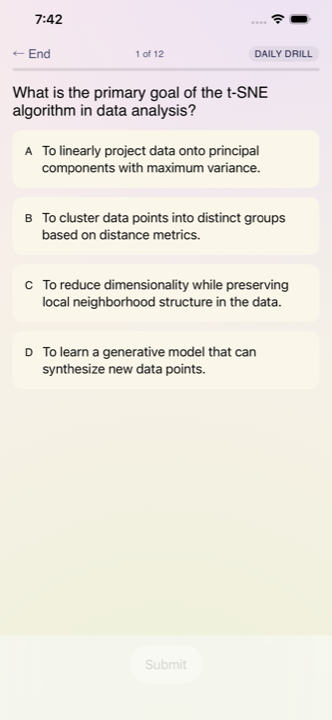
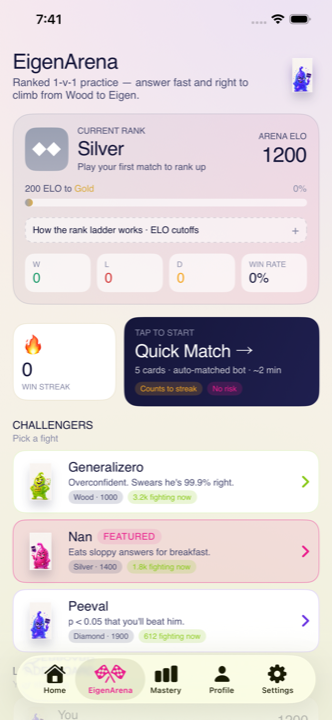
Yes. All eight Data Science & AI domains are open from day one, at the full difficulty range — we never paywall the questions or lock a domain. What the free tier meters is volume: a daily deck of cards shared across study and the Arena. Pro lifts that limit entirely.
What are the ads for?+
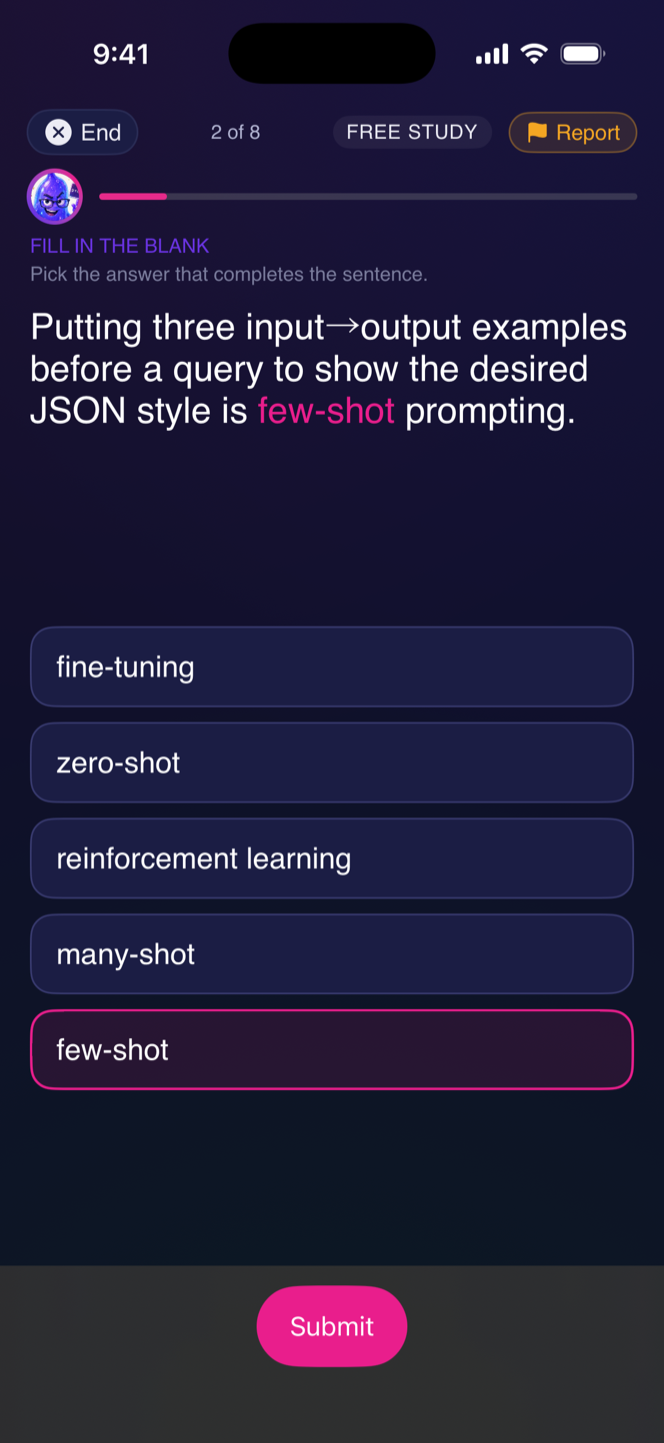
Free play runs on a daily allowance of cards. When you run out, you can watch one short clip (we're aiming for 15–20 seconds) to top up and keep going — or just come back tomorrow, it refills. Pro removes ads entirely and makes cards unlimited. We're testing this — tell us if it feels fair.
Why no public numbers right now?+
Because they'd be made up. Calibration, flag rates, accuracy — those are measurements, not promises. The day we have real data, we'll publish it live, refreshed once a day. Until then we'll only describe what we're building.
How do you keep quality high without burning money?+
Flagging a card queues it for that night's review — a flag never hides a card on its own, so nobody can bury good cards by flagging them. The expensive work, LLM re-review and regeneration, runs once a day over a single capped batch of the most-flagged cards, never per-tap, and only a failed review pulls a card. So neither flag-spam nor a flood of bogus flags can hide content or run up the bill.
What does my EigenScore mean?+
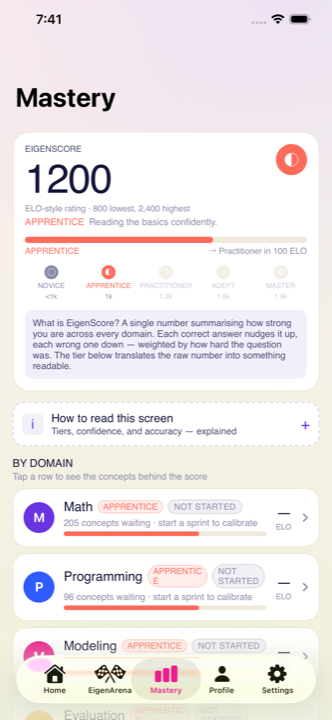
It's a per-domain ability rating on the 800–2400 ELO scale — same as chess. A score of 1500 means you're predicted to get a 1500-rated card right about 50% of the time. The system updates both your rating and the card's after every answer.
Who is this for?+
Working data scientists, ML engineers, and AI engineers brushing up — and serious students preparing for interviews. The curriculum assumes you know calculus and have written code before.